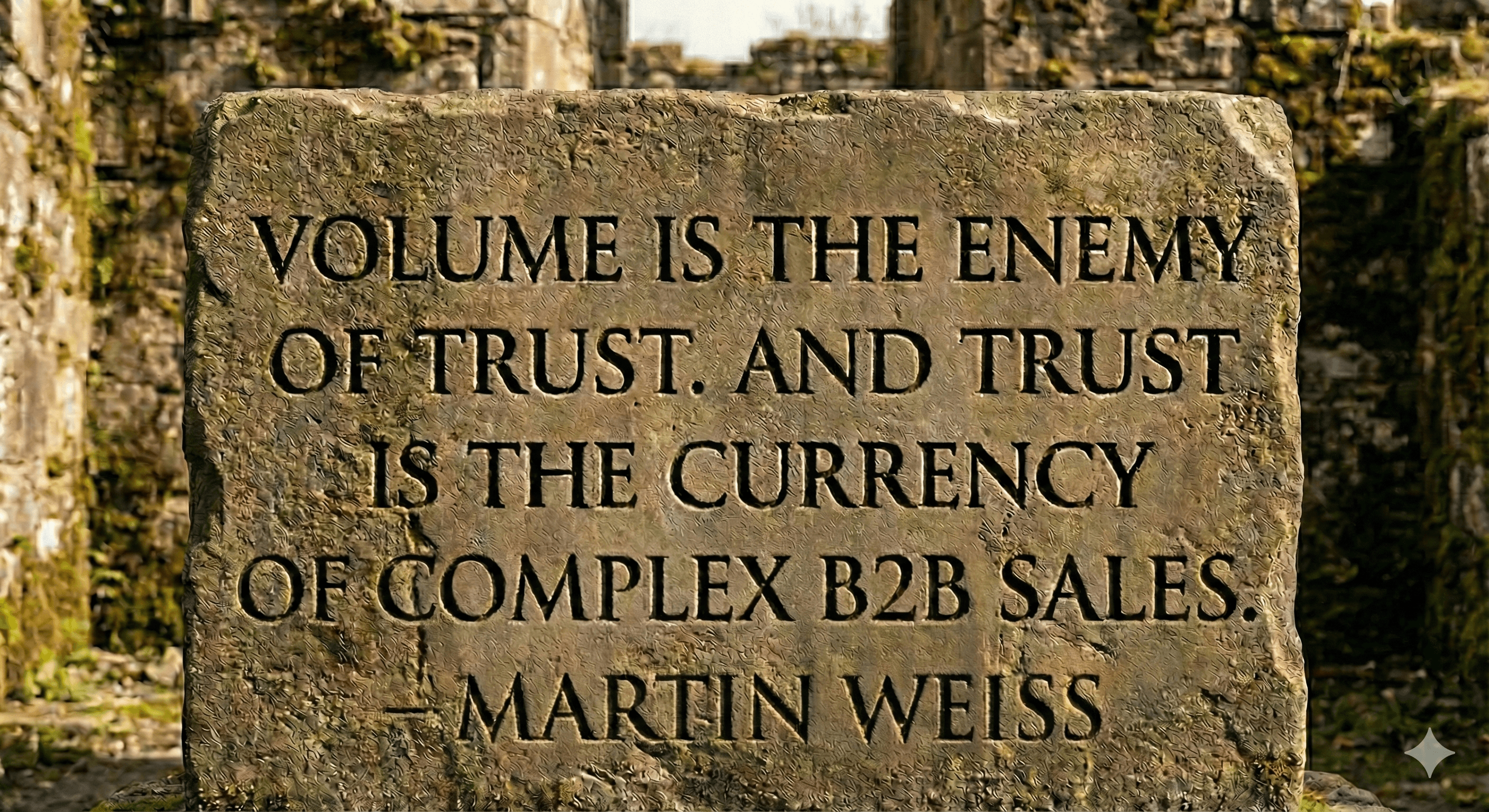
Early-stage B2B sales today is paradoxical.
It is more engineered than ever and more disconnected than ever.
Teams invest heavily in tools, sequences, playbooks, and automation. They hire brilliant engineers and analytical minds, then try to GTM-engineer sales into a predictable machine. More signals. More steps. More volume. More activity.
And yet pipelines stall, response rates collapse, and trust erodes.
Not because sales has become harder.
But because it has become less human.
The Illusion of Control Through Volume
Most early-stage B2B teams default to volume for one simple reason: it feels controllable.
You can measure:
Emails sent
Touchpoints executed
Accounts added
Activities completed
Volume creates the comforting illusion that progress is being made.
But in complex B2B sales, especially in DACH markets, volume does not create momentum. It creates resistance.
Decision-makers are not overwhelmed because vendors lack tools.
They are overwhelmed because every tool makes it easier to reach them without earning the right to do so.
The result is predictable.
More outreach leads to less attention.
More automation leads to less credibility.
More activity leads to less trust.
Why Trust, Not Reach, Moves Complex Deals Forward
Complex B2B buying decisions are not transactional events. They are risk-management exercises.
Buyers are asking themselves:
Can I trust this vendor to understand my reality?
Can I trust them to tell me hard truths, not just sell?
Can I trust them when things get complex internally?
No CRM, automation platform, or AI assistant can answer those questions on your behalf.
Trust is not built through frequency.
It is built through judgment, relevance, and restraint.
And restraint does not scale easily.
The Cost of Over-Engineering Early Sales
Early-stage teams often make a critical mistake. They try to systemise sales before they have learned how trust is actually earned in their market.
They design sequences before conversations.
They optimise messaging before listening.
They automate before they understand nuance.
This leads to technically correct sales motions that feel emotionally wrong.
From the buyer’s perspective, these motions signal:
Distance instead of presence
Incentive instead of intent
Efficiency instead of care
Once that signal is sent, no follow-up fixes it.
Conversations Are Not a Channel. They Are the Product.
In complex B2B sales, the conversation is the "product before the product".
Early conversations are where:
Problem definitions are shaped
Internal language is mirrored
Buying groups align or fragment
Risk is reduced or amplified
When sales teams treat conversations as a throughput problem, they destroy their own leverage.
The goal is not more conversations.
The goal is better conversations with fewer, better-chosen people.
That requires:
Technical depth
Commercial curiosity
Human presence
The willingness to slow down
None of these fit neatly into dashboards.
Why DACH Markets Expose This Faster Than Others
DACH buyers are particularly unforgiving of volume-led sales motions.
Not because they are anti-sales, but because they value:
Precision over persuasion
Substance over storytelling
Credibility over charisma
Here, trust is not granted early.
It is earned quietly, over time, through consistency and competence.
Sales motions that might survive elsewhere collapse quickly in DACH because they reveal intent too early and substance too late.
Rebalancing Sales From Engineering Back to Judgment
This is not an argument against systems, tooling, or structure.
It is an argument for sequence.
Trust must come before scale.
Understanding must come before automation.
Judgment must come before process.
The teams that win in complex B2B are not the ones with the most sophisticated stacks, but the ones that can balance:
Technical excellence with human credibility
Structure with flexibility
Insight with humility
Until that balance exists, no amount of tooling will save the pipeline.
A Final Thought
Volume is tempting because it feels productive.
Trust is harder because it cannot be forced.
But in complex B2B sales, trust is the only currency that compounds.
Everything else depreciates faster than most teams expect.